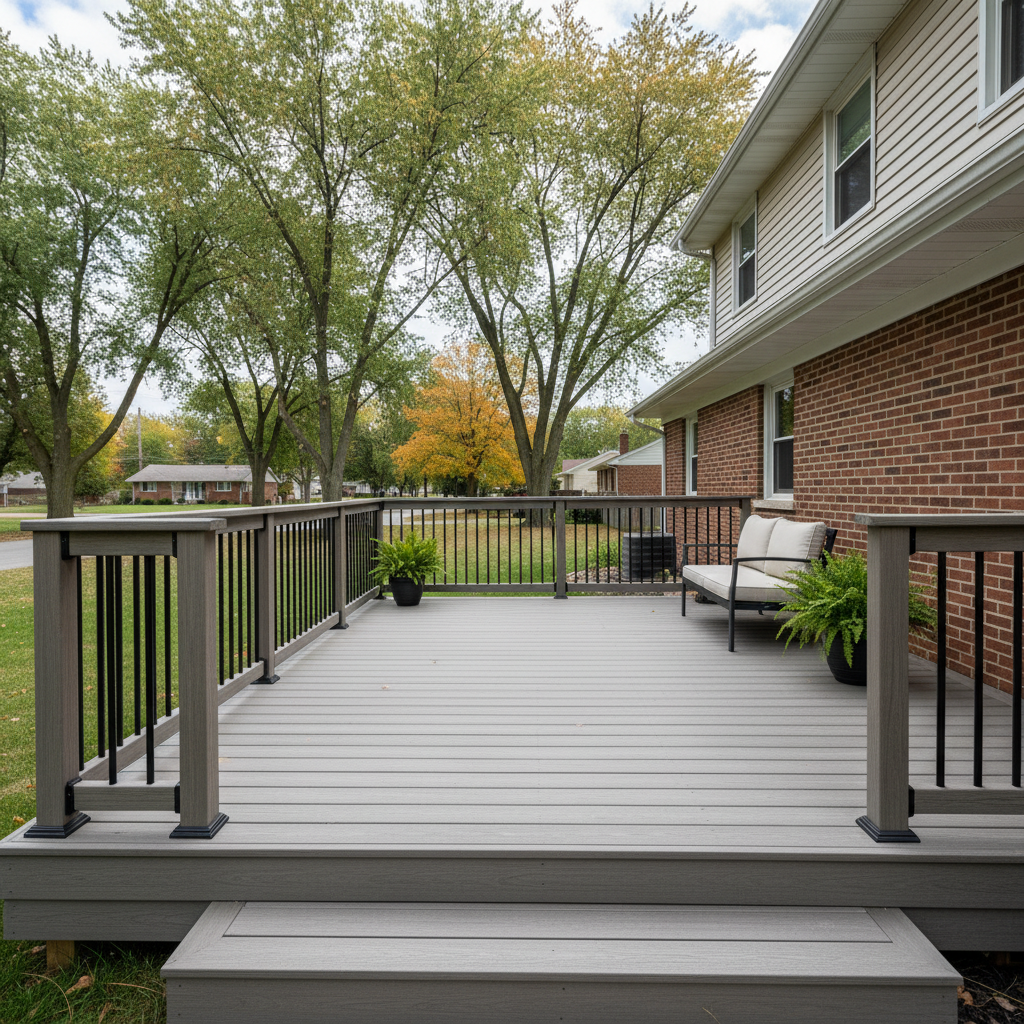
Alright, let's talk about composite decks. Everyone wants one these days, and for good reason. They look great, last forever, and you don't have to spend every spring staining them. But then you start looking at prices, and it can feel like you're trying to decode a secret language. What's a fair price? What are you actually paying for? I get these questions all the time, so let's clear things up.
What Makes Composite Deck Prices Jump Around?
You'll hear a lot of folks say, 'it depends.' And yeah, it does, but that's not helpful. Let's get specific on what those 'depends' really are:
Size and Shape: This is a no-brainer. Bigger deck, more material, more labor. But shape matters too. A simple square or rectangle is always cheaper to build than a multi-level, curved, or angled deck. Every extra corner or curve adds complexity and time.
Material Grade: Not all composite is created equal. You've got your basic capped composites, which are good. Then you move up to premium lines with more realistic wood grain, better fade resistance, and often a longer warranty. Brands like Trex, TimberTech, and Azek all have different tiers. The entry-level stuff might run you $4-6 per linear foot for decking boards, while the top-tier can hit $8-12+ per linear foot. That adds up fast on a big deck.
Foundation & Framing: This is the backbone of your deck, and it's where you absolutely don't want to skimp. Here in Detroit, especially with our clay soils and freeze-thaw cycles, proper footings are critical. We're talking concrete piers dug deep enough to get below the frost line – usually 42 inches around here. If your yard slopes, or you want a deck high off the ground, that means more complex framing, taller posts, and possibly more concrete. All that costs more.
Railing System: This is a huge variable. Pressure-treated wood railings are the cheapest, but they need maintenance. Composite railings are low-maintenance but cost more. Aluminum railings are sleek and durable, often in the middle. Glass panel railings or custom metalwork? Those are going to push your price way up. A basic composite railing might be $40-60 per linear foot installed, while a premium aluminum or glass system could be $100-200+ per linear foot.
Add-ons & Features: Stairs, benches, pergolas, built-in lighting, planter boxes, even a fancy picture-frame border on your deck – all these things add to the material and labor cost. Every step, every light fixture, every custom bench means more time and specialized work.
Site Access: Sounds minor, but if we can't get equipment or materials easily to your backyard, it takes longer and costs more in labor. Tight spaces, steep hills, or a long haul from the street can all impact the final price.
So, What's the Typical Range for a Composite Deck in Detroit?
Okay, let's get down to brass tacks. For a professionally installed composite deck in the Detroit area, you're generally looking at:
Basic Composite Deck: For a simple, ground-level or low-height deck (say, 10x12 to 12x16 feet) with standard composite decking and basic composite railings, you're probably in the range of $35-50 per square foot. This would be using a mid-range composite material.
Mid-Range Composite Deck: For a larger deck (16x20 feet or more), maybe slightly elevated, with a more premium composite board, a nicer railing system (like aluminum balusters), and a set of stairs, you're looking at $50-70 per square foot.
High-End/Custom Composite Deck: If you want multiple levels, intricate designs, top-tier composite materials, custom railings, built-in lighting, benches, and other bells and whistles, expect to pay anywhere from $70-100+ per square foot. This is where your dream deck comes to life, but it comes with a price tag to match.
Remember, these are averages. A 200 sq ft deck at $50/sq ft is $10,000. A 400 sq ft deck at $60/sq ft is $24,000. The total cost can vary wildly depending on your choices.
What Should a Good Quote Include?
When you get a quote from a reputable contractor like Top Line Decks Detroit, it shouldn't just be a single number. You want to see a breakdown:
Detailed Material List: Specific brand and line of composite decking, type of railing, fasteners, concrete for footings, lumber for framing, etc.
Scope of Work: What exactly are they building? Dimensions, height, number of stairs, any special features.
Labor Costs: Often lumped in with materials, but a good contractor can show you how they estimate this.
Permits & Inspections: Who handles them? This is crucial. In Detroit, you absolutely need permits for decks, and inspections are required to make sure it's safe and up to code.
Site Preparation & Cleanup: Does it include old deck demolition? Hauling away debris? A clean job site is a sign of professionalism.
Warranty Information: What's covered by the contractor, and what's covered by the material manufacturer?
How to Avoid Overpaying for Your Composite Deck
Get Multiple Quotes: Don't just go with the first guy. Get at least three detailed quotes from different, reputable contractors. This lets you compare apples to apples.
Check References & Reviews: A low price isn't a deal if the work is shoddy. Look for contractors with a solid track record and good reviews. Ask for pictures of their work.
Be Specific About What You Want: The more detailed you are with your vision, the more accurate the quotes will be. Changing your mind halfway through construction is almost always more expensive.
Understand the Materials: Do your homework on composite brands. Know the difference between a basic capped board and a premium one. Don't let someone upsell you on something you don't need, but also don't cheap out on critical components.
Don't Pay in Full Upfront: A reasonable down payment (20-30%) is normal. Be wary of contractors who demand a huge percentage upfront, especially for materials they haven't even ordered yet.
Prioritize Safety & Structure: Never compromise on the foundation and framing. It's the part you don't see, but it's what makes your deck safe and last for decades. Cutting corners here is a recipe for disaster.
A composite deck is a big investment, but it's one that adds real value and enjoyment to your home. Do your homework, ask the right questions, and you'll end up with a beautiful, long-lasting deck that you and your family will love for years.